

You Can’t Fix What’s Built Wrong
It usually starts with the right intentions. A pre-commercial pharma team is preparing for launch: scoping out field operations, making CRM decisions, and beginning to think about analytics. Everyone is focused on execution.
But beneath all of that activity, one critical question gets overlooked: Is your data infrastructure ready to support what’s coming?
In too many cases, the answer is no. Decisions are made in silos. Vendors are brought in late. And systems meant to support growth instead become roadblocks. We’ve seen fast-moving launch plans that quickly spiral into a patchwork of tools, fragmented data flows, and black-box environments that are difficult to manage and nearly impossible to fix.
Too often, data strategy is treated as a tech project, not an operational imperative. When infrastructure planning isn’t done early and with growth in mind, companies find themselves rebuilding systems midstream just to keep up.
According to McKinsey research, around 70% of digital transformation programs fail, many times because organizations underestimate the complexity of change and overemphasize the technology itself. This rings especially true for launch-stage pharma teams, where tech-first decisions leave operations scrambling to keep up.
The Most Common Mistakes—and Why They’re So Expensive
 It starts small: a CRM decision made in isolation. A quick vendor contract to meet a tight deadline. A team spinning up its own dataset to keep things moving. Each choice makes sense in the moment— but together, they add up to long-term complexity
In our work with life sciences teams, we’ve seen three patterns surface over and over. Each one creates downstream issues that are hard to fix and even harder to scale.
MISTAKE 1
Delaying data strategy until CRM or field team decisions are already made
Many pre-commercial organizations focus first on sales tools and vendor selection, assuming data will fall into place later. By the time CRM implementation begins, the window to architect your data environment proactively has already closed.
Gartner research shows “poor data quality costs organizations an average of $12.9 million annually.”
That’s because foundational decisions are made reactively—driven by short-term launch needs instead of long-term scale. And when you’re forced to rebuild later, you lose momentum, control, and budget you can’t get back.
MISTAKE 2
Siloed data procurement—marketing, medical affairs, and commercial ops all contracting separately
When different functions procure data in silos—like marketing, medical affairs, and commercial operations—the result is redundancy, conflicting datasets, and more time spent reconciling records than making decisions. That may mean buying the same data twice, or worse, relying on conflicting datasets.
A recent IDC analysis shows that teams purchasing tools independently, commonly known as shadow IT, can undermine efficiency through redundant systems, hidden fees, and lack of integration. In fact, fragmentation often increases time spent managing data and contributes to sizable operational waste
Alignment early on is necessary for a successful launch. It allows shared governance, reduces loss, and makes future integration more seamless.
MISTAKE 3
Choosing big-name vendors that create black-box environments and long lead times
Large vendors may seem like a safe bet, but many times they deliver rigid, opaque environments where even small changes require long delays or custom SOWs. Clients lose transparency, autonomy, and the ability to pivot quickly.
What’s sold as enterprise-grade can become the biggest bottleneck. Flexibility and ownership matter more than logos, especially at early stages.
This becomes even more evident during moments of change, like mergers or affiliate launches. Mergers and acquisitions in life sciences surged in 2023, with deal volume growing 23% year-over-year after the pandemic. Yet a recent McKinsey study shows more than 40% of these outcomes fall short of integration value due to misaligned systems.
We’ve seen the impact firsthand. A pre-commercial life sciences company had spent nearly a year working with a major vendor—but progress was stalling. Their system was rigid, with limited transparency, and even simple changes took weeks.
Conexus was brought in to rearchitect the setup. In just 10–12 weeks, the team rebuilt everything—this time in the client’s own cloud environment, with full control, speed, and transparency from day one.
“By the time clients come to us, they’ve already spent months with large vendors—locked into black-box setups where change is slow, costly, and no one’s talking to each other.”
– Sunitha Venkat, VP, Data Services and Insights, Conexus Solutions, Inc.
WHEN COMPLEXITY ESCALATES:
Mergers, Affiliates, and Global Teams
As organizations grow or expand across borders, foundational cracks in data strategy tend to widen. The complexity isn’t just technical. It’s operational, contractual, and deeply tied to ownership.
This is where you either double down on complexity, or take the opportunity to build a better foundation.

Affiliate Launches and Cross-border Strategy
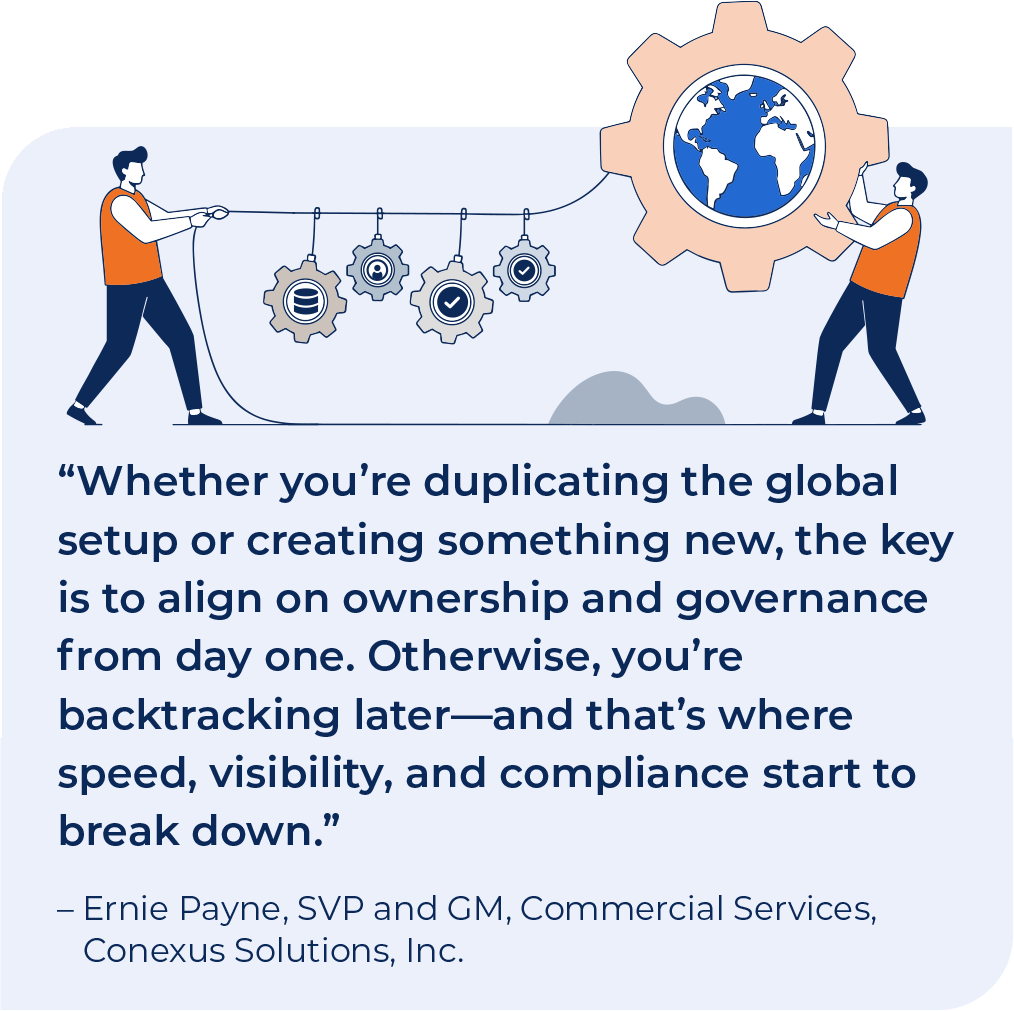
When EU parent companies launch U.S. affiliates, friction often emerges around autonomy versus global alignment. These aren’t just technical debates. They shape how data contracts are structured, who owns platform decisions, and how future integrations will work.
One EU-based pharma launching a U.S. affiliate had to make the call: sync with the global system or build from scratch? The decision defined not just their architecture, but their future agility.
Without early clarity on governance and ownership, even well-architected systems can become liabilities.
M&A Scenarios
When mergers bring together two organizations with different platforms, vendors, and governance models, it’s rarely a clean handoff and the stakes are high.
In the case of a newly merged pharma company it found itself with two legacy systems that couldn’t talk to each other. Reporting stalled and governance broke down. Instead of trying to force alignment, the client brought in Conexus to rebuild from the ground up.
Within weeks, the team stood up a new data architecture—complete with master data management (MDM), centralized ownership, and clean analytics pipelines.
Beyond a short-term problem, this decision became the foundation for post-merger growth.
The Do’s and Don’ts of Building a Scalable Data Foundation
 Strong data environments are the result of early, intentional choices—not reactive fixes that create friction down the line. Here’s what we’ve learned from helping life sciences teams design infrastructure that drives speed, ensures clarity, and holds up under pressure.
Do: Start 12–18 months before launch
Early planning sets the stage for a unified environment—one where vendors, systems, and internal teams are aligned from day one. Starting early gives you time to architect data infrastructure that supports future growth, not just immediate tasks.
Don't: Rely on point solutions that won’t scale
Short-term tools may seem efficient, but they can create downstream bottlenecks. If your CRM, analytics, and data infrastructure aren’t designed to evolve together, you’ll be forced to rework or replace them at the exact moment you need them most.
Do: Choose a platform and partner that give you full control
Select a vendor who offers transparency, flexibility, and full access to your data platform—not a locked “black box.” Prioritize partners willing to build in your cloud environment, so you own the infrastructure, the roadmap, and the pace of change. This ensures long-term scalability, faster enhancements, and full system insight.
Recently Conexus restructured the architecture in a client’s own cloud—giving their team full access, faster decision making, and the ability to evolve on their terms. This solution helped them escape a rigid vendor setup that offered little visibility or control where even simple changes took weeks.
A modern R&D tech stack integrating clean data architecture with next-gen tools could boost productivity and shave 15–30% off setup and trial timelines.
Don't: Skip master data management (MDM)
Without a strong MDM framework, duplicate records, conflicting HCP profiles, and reporting errors are inevitable. Even if clients don’t ask for it, MDM should be baked in from the start. It’s what ensures consistency across touchpoints, makes governance possible, and lays the groundwork for future AI and automation.
If you’re not sure what that core structure should look like, we break it down in the 2025 Life Sciences Guide to AI Readiness—a practical look at structuring your architecture for speed, trust, and scale.
“You can’t deliver trusted analytics if your upstream data sources aren’t aligned. MDM isn’t optional—it’s what lets downstream tools actually work.”
– Sunitha Venkat, VP, Data Services and Insights, Conexus Solutions, Inc.
From Data Strategy to AI-Readiness: Connecting the Dots
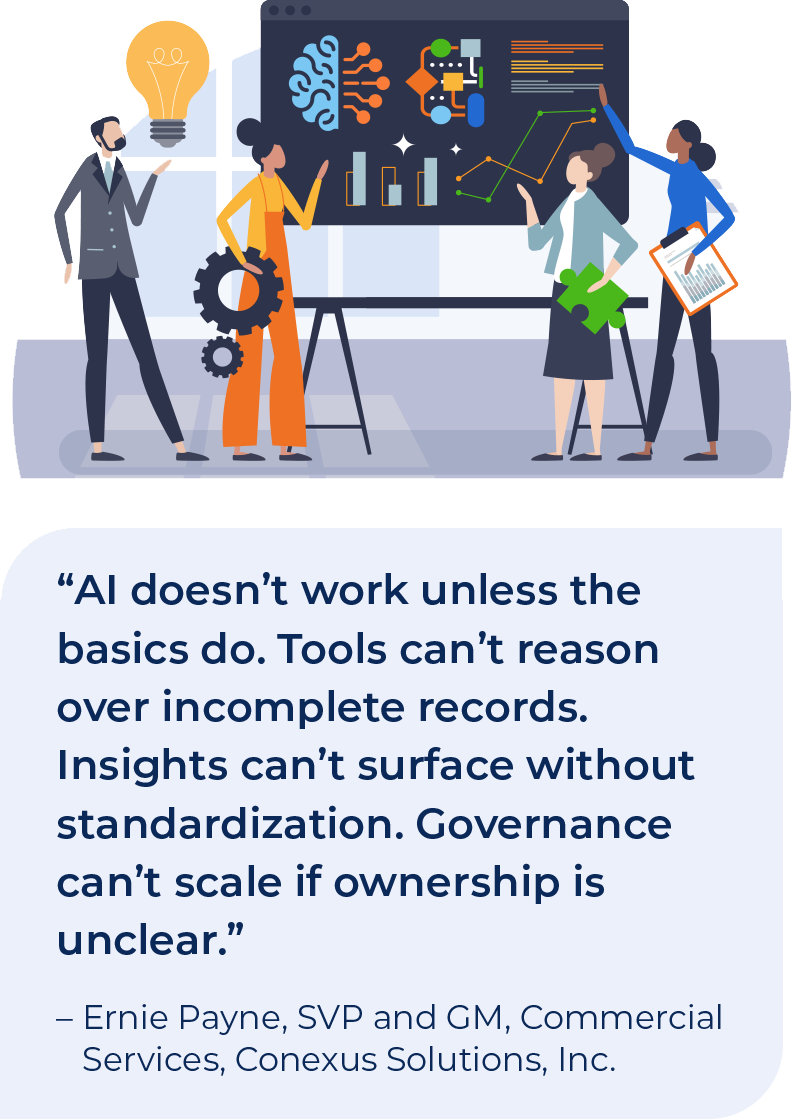
By now, you recognize that AI isn’t a distant goal, it’s on the roadmap. But, what’s less clear is how to get there without backtracking.
The challenge is the operational weight of legacy systems, inconsistent governance, and environments that weren’t designed for growth. Your teams aren’t blocked by the technology, they’re blocked by what lies beneath it. For those with a strong foundation, AI becomes an accelerant.
For others, it’s a mirror—exposing the limits of decisions made years earlier.
But readiness is possible. Teams that took the time to align early, invest in MDM, and build their own architecture are already exploring GenAI use cases with clarity and speed. If you’re starting late, you’re not behind.
But you do need to approach it differently. It’s not about layering AI on top. It’s about ensuring what’s underneath is solid enough to support it.
CHECKLIST:
Building Data Foundations That Scale
If you’re preparing for launch, or laying the groundwork for long-term growth, these are the moves that position your data strategy to go the distance.


Conexus partners with life sciences teams to design data ecosystems built for growth— streamlined, connected, and ready for the future.
We help you:
- Architect flexible environments that adapt as you scale
- Implement master data management to ensure consistency and trust
- Align platforms, vendors, and teams around a shared strategy
- Reduce friction across systems and speed up decision-making
- Lay the groundwork for AI-driven analytics and automation