

If your next board meeting has “AI strategy” at the top of the agenda, you’re not alone. Nearly every mid-market pharma leader is pressured to show tangible progress on new digital initiatives. But behind closed doors, many admit the infrastructure just isn’t there yet.
You can’t build a next-gen pharma company on a shaky foundation. Rushing into automation and advanced analytics without unified, trustworthy information can slow you down and even derail your entire strategy.
As Ernie Payne, Conexus Solutions, Inc. Senior Vice President & General Manager of Commercial Services, warns,
“If you don’t get the foundational business principles right, it doesn’t matter who you hire or how smart they are – it’s likely to underperform or fail.”
Here’s what it really takes to get AI-ready and why the backbone of your data systems, not your algorithms, is the place to start.
What’s Really Holding AI Back in the
Life Sciences Industry?
AI may dominate industry headlines, but most companies just aren’t seeing the results.
A joint report by McKinsey and The Wall Street Journal found that only 1% of U.S. companies have successfully scaled AI, while 43% remain stuck in pilot mode.
This mirrors what we’re seeing across the midmarket pharma space. Organizations are eager to move fast, but foundational gaps keep getting in the way. Fragmented systems. Inconsistent governance. Information trapped in silos.
When these issues go unaddressed, models fail, insights misfire, and strategies stall. Until companies confront these realities head-on, AI will stay stuck in theory while competitors build on stronger foundations.
The message is clear: everyone’s investing, but very few are ready
UNDERSTANDING THE “DATA SPINE”:
Your Single Source of Truth
Ask just about any IT leader what’s holding them back from scaling AI, and most won’t say “strategy.” They’ll say “systems.” But the reality is, it’s the absence of a true data spine
A data spine is more than an integration layer or a well-maintained CRM. It’s a reliable, consistent foundation that connects information across departments, platforms, and workflows.
When built intentionally, it becomes the single source of truth teams can trust to inform decisions, power automation, and support AI use cases.
At Conexus, we often work with companies that believe integration is complete because platforms are technically connected. However, the underlying data is still fragmented, poorly governed, or misaligned across teams
What happens is that business users don’t trust the outputs, and strategic insights stall before they scale.
This is especially common in mid-sized pharma environments, where the pressure to deliver visible results can lead to isolated data efforts— dashboards, data lakes, or pilots—without the foundation to support them.
 Unlike large enterprises, mid-market firms don’t always have the luxury of multi-year data transformation programs, which makes the approach even more important. Leaders must prioritize building a flexible spine that supports today’s use cases while preparing for tomorrow’s.
The goal isn’t simply to connect systems. It’s to create a foundation on which people across the organization can confidently rely.
We help clients ground their data strategy in how the business runs—how teams work, how decisions are made, and where information breaks down.
Turning CRM into Your Strategic Asset
For many mid-market pharma companies, CRM is the most underleveraged asset in the tech stack. It’s already embedded in daily operations—used by commercial teams, referenced by medical affairs, and touched (directly or indirectly) by leadership. But in most cases, it’s not fully aligned with broader data strategy goals.
Clients often treat CRM systems as operational tools rather than strategic data assets.
While CRM platforms such as Veeva and Salesforce offer robust options for organizations to collect, communicate, and illustrate strategic data sets, many organizations still utilize these applications as point solutions for tracking HCP interactions or managing account hierarchies. What gets overlooked is their potential to act as a launchpad for cross-functional data integration
Rather than investing in entirely new systems, we guide clients to maximize their existing systems—CRM is one of the most immediate and impactful.
Instead of chasing new tools to “get AI ready,” pharma leaders can often start by extracting more from what’s already in place. CRM can become the connective tissue that unifies information across field teams, medical liaisons, marketing, and compliance when properly structured. It’s one of the few systems that touches almost every stakeholder in the organization, which makes it a powerful candidate for strengthening internal data flow
CRM often becomes a proving ground. When data from it is structured, governed, and shared across teams, it creates internal alignment and drives broader transformation.
We’ve found that this kind of realignment— elevating CRM from a tracking tool to a cross-functional connector—gives teams a tangible early win. It shows that data unification can start using tools already in place. That momentum often extends into broader engagement strategies, especially omnichannel.
Where Strong Data Shows
Immediate ROI
Omnichannel strategies quickly expose a company’s data foundation’s strength or weakness. When information is disconnected, messages miss the mark, handoffs break down, and HCPs get frustrated. But with complete, structured, and accessible data behind every interaction, engagement becomes timely, relevant, and measurable.
We see omnichannel as one of the fastest ways clients realize ROI from better data practices. It’s visible, measurable, and cross-functional, making it a strong proof point for leadership.
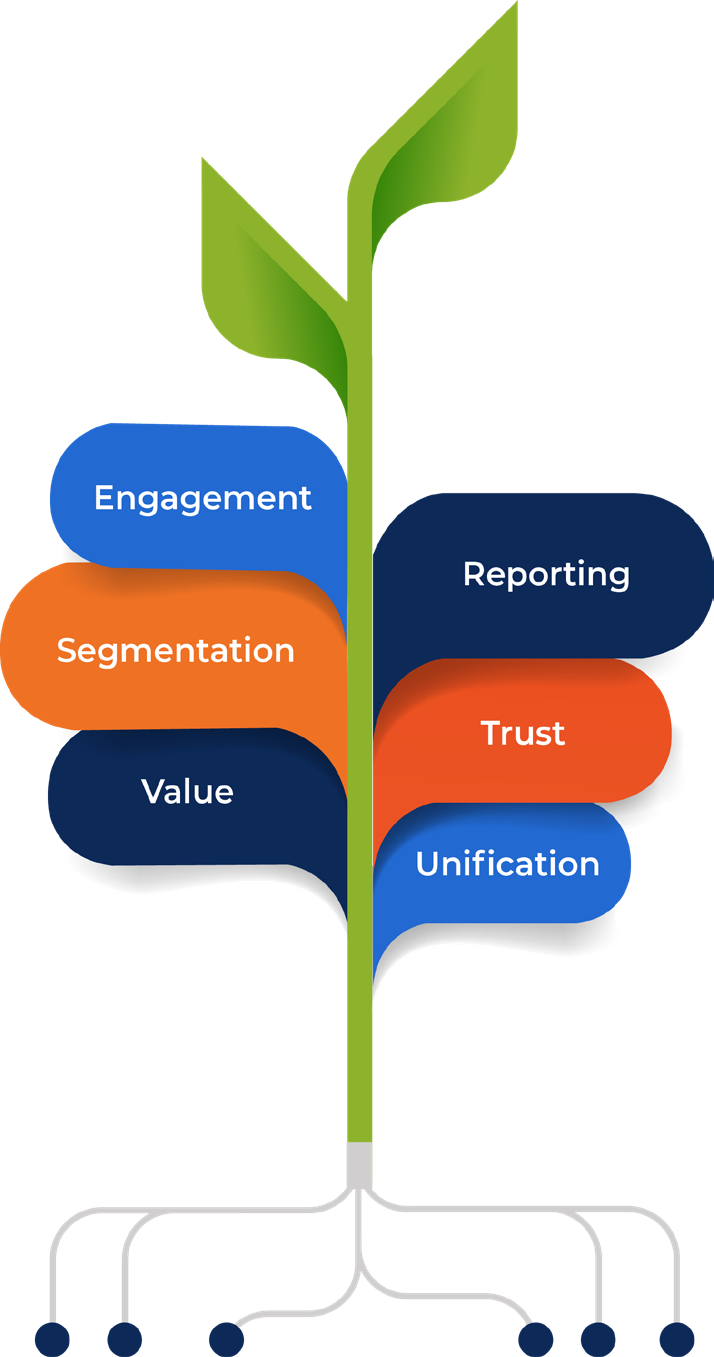
Once early wins in omnichannel performance, such as higher engagement, better segmentation, and more transparent reporting, are visible, organizations begin to trust the value of building unified data. That trust becomes a catalyst for long-term change.
The Culture Shift Behind Data-Driven Decisions
Initial gains are essential. However, sustaining progress depends on how data is accessed and used, not just where it lives.
Democratizing data means creating clarity around access: who needs it, how they use it, and what support they need to make it meaningful.
We often see hesitation rooted in fear: misuse, regulatory exposure, or simply losing control. However, when managed with intention, access becomes a driver of ownership and accountability.
Gartner predicts that 60% of organizations will fail to realize the anticipated value of their AI use cases by 2027, primarily due to weak or incohesive data governance frameworks. This makes governance not just a compliance issue, but a cultural one.
We help clients build models where access doesn’t mean chaos. It means accountability. When teams trust the data, they engage with it, challenge it, and act on it.
THE WORK THAT ACTUALLY GETS YOU AI-READY:
Our Strategic Recommendations
 AI readiness starts where most companies least expect it—in the questions they haven’t answered.
What data do we even have? Who owns it? What defines quality? How is information shared across functions when priorities shift?
At Conexus, this is precisely where we start. You can’t scale what you don’t understand. We help teams map what’s working, where friction lives, and what foundational choices must be made before AI use cases are viable.
Here’s how organizations can build lasting capability—step by step:
Phase 1: Set Direction from the Top
The most successful AI efforts begin with clear executive direction. Before launching any initiative, companies need executive-level clarity on purpose, priorities, and guardrails.
That means defining:
- Your AI mission
(e.g., “get products to market faster”) - Acceptable use guidelines
- Business outcomes that matter most
Leaders often focus on the tools themselves, but foundational alignment determines whether those tools drive results. As Payne notes,
“Tools amplify alignment—they don’t create it.” That clarity has to come first.
Without top-down alignment, AI efforts risk becoming fragmented or misinterpreted. A simple, well-communicated mandate sets the tone and clears the path.
Phase 2: Formalize Lightweight Governance
Strategic clarity only goes so far without a mechanism for action. AI initiatives require coordination, accountability, and visibility across functions, even in lean organizations.
Start by identifying who will guide and oversee your efforts. This could be a small, crossfunctional group tasked with reviewing use cases, defining risk thresholds, and aligning expectations. Assigning data ownership and setting basic SOPs creates the operational discipline needed to move forward without chaos.
Lightweight governance makes alignment repeatable and ensures every AI project stays connected to business outcomes, not just technical curiosity.
Phase 3: Build the Infrastructure and Guardrails
Once governance is in place, focus on reinforcing your data spine. This is where most organizations rush and later regret it.
Start by prioritizing what matters most: clean, connected, and compliant data. Identify critical sources, reduce duplication, and resolve inconsistencies that erode trust. Integration should serve the business, not just the systems.
Next, embed the proper controls. In life sciences, that means designing with compliance in mind from the beginning. Set up audit trails, define review processes, and ensure AI outputs can be monitored and explained. Keeping a human in the loop isn’t just best practice—it’s often required.
The fastest organizations don’t skip this step. They invest in it early and avoid rebuilding later.
Phase 4: Align, Pilot, and Capture Feedback
Effective pilots begin with clearly defined goals and shared expectations. Define what you’re testing, what success looks like, and who needs to be involved from the start. When teams understand the goals and their role in the outcome, it’s easier to avoid miscommunication, slowdowns, or scope drift.
Build in transparency from the start. Users must understand how AI outputs are generated and why they’re being surfaced, especially in hightouch roles like field sales. As Payne explains,
“If a rep gets a next-best action but has no idea where it came from, they won’t trust it. Give them context. Give them a way to respond.”
Collect feedback early and often. A solid feedback loop helps refine the model, catch blind spots, and strengthen buy-in. Internal trust doesn’t come from dashboards—it comes from involvement
Phase 5: Operationalize and Keep Evolving
Once the pilot proves value, you can move quickly to scale, but don’t treat it as a finish line.
Capture what worked, document lessons learned, and apply them consistently. Keep monitoring model performance, tracking KPIs, and collecting feedback from users.
This isn’t a one-time rollout. It’s a shift in how the business operates and makes decisions. Payne says,
“If you haven’t built the launchpad, you’re not going to Mars. You’re not even getting off the ground.”
Invest in what’s next by maintaining what’s working. The most AI-ready teams don’t chase trends; they build durable systems that can evolve with the tech.
How Smart Teams Move Beyond Pilots
Most companies want to accelerate their AI journey. But speed without a solid framework leads to stalled pilots, wasted investment, and internal fatigue.
The organizations that move forward don’t necessarily have the biggest tech stacks. They’re the ones with a focus on their data, their priorities, and the way decisions are made.
“AI can’t be a one-time initiative. Tech’s evolving behind the scenes, and you need to be ready for what’s next without rebuilding from scratch.”
– Ernie Payne
AI readiness is less about the future and more about how clearly you understand the present. That understanding doesn’t come from a roadmap. It comes from doing the work by auditing, aligning, and committing to the kind of foundation that AI can actually build on.
At Conexus, we help life sciences teams move from stalled pilots to scalable AI wins faster and with fewer setbacks.
Here’s how we help you:
- Choose technologies that fit your vision—and your reality
- Spot hidden value in the data you already have
- Build roadmaps that balance speed, structure, and scale
- Turn data insights into new sources of revenue
- Launch fast, focused pilots that clear the path for enterprise-wide adoption