

Approval is approaching, and excitement builds across the organization. Years of research and regulatory work have led to this point, but as the finish line nears, a familiar question surfaces: are we truly ready to go live?
Readiness involves far more than crafting a single message. It is the orchestration of many moving parts all working together to ensure every element is accurate, compliant, and ready for market.
However, this is precisely where many teams struggle. Last-minute feedback, disconnected systems, and shifting timelines can slow everything down when speed matters most. Building stronger marketing operations early helps prevent those bottlenecks and keeps launches on track.
This article explores practical ways to strengthen those foundations by easing last-minute pressure, improving brand–agency coordination, and using campaign management to drive consistent execution.
Where Launches Break Down
A campaign is days from go-live. The pressure mounts as teams work to finalize messaging, confirm audience definitions, and lock in business rules for marketing outreach. Then, just as approval nears, the FDA sends its final notice—and key details shift. Safety information, pricing, and language updates must move quickly through legal and regulatory review before being integrated into content, tested, and launched
These are the moments that reveal whether the operational groundwork is strong enough to withstand pressure.
In smaller or fast-growing pharma organizations, challenges often emerge behind the scenes, where disconnected tools and unclear workflows can derail even the strongest plans. In fact, nearly 60% of life sciences companies say fragmented systems are their biggest barrier to delivering consistent customer engagement.¹
What separates teams that react to issues from those that anticipate them is how effectively they align and communicate.
With the right infrastructure, planning turns into performance—linking technology, content, and compliance so everything moves in sync. Across dozens of commercial launches, one pattern is clear: teams that invest early in marketing operations build the stability and speed needed for success.
Nearly 60% of life sciences companies say fragmented systems are their biggest barrier to delivering consistent customer engagement.¹
The Core Elements of a Strong Operational Foundation
Together, these components form a unified marketing operations framework that connects omnichannel strategy, automation, journey mapping, personalization, email marketing, and digital engagement. Each element supports consistent and compliant communication across every audience.

Connectivity
Integrated platforms such as CRM, marketing automation, and patient support programs that share data efficiently

Usability
Modular, pre-approved content that can be updated and deployed quickly

Accountability
A structured testing and MLR review process that keeps messaging accurate and compliant
When the Process is
Put to the Test
- During a pre-launch campaign, a technical issue surfaces late in development. The fix needs to happen fast, but the team can’t afford to disrupt the schedule or skip compliance checks.
- Because the workflow is clearly defined, the issue is flagged immediately, the right people are pulled in, and communication stays open as the fix moves through testing.
- Within hours, the problem is resolved, the campaign stays on schedule, and everyone involved knows exactly what is happening at each step. It’s a small moment, but it shows how structure and communication turn pressure into progress
The habits that make that kind of teamwork possible start long before approval day.

How Teams Turn Planning into
Performance Before Go-Live
 By now it’s clear, a smooth go-live comes from clear planning, smart sequencing, and teams that know exactly what needs to be ready ahead of time.
Here’s what that looks like in practice.
Step 1: Start Planning as Soon as Strategy Is Set
Once everyone agrees on the marketing goals and success metrics, planning should begin right away. Budgets are confirmed, tools are assigned, and the campaign calendar starts to take shape. This is when the team outlines what needs to be built, from email journeys and CRM setups to reporting dashboards and analytics tracking.
It is also time to identify early milestones, such as content development, legal and medical reviews, and system testing. Teams that begin this work months ahead avoid the last-minute scramble when timelines tighten.
According to McKinsey’s Commercial Excellence in Life Sciences report, organizations that establish integrated commercial and marketing operations at least six months before launch achieve campaign deployment 35% faster.²
Step 2: Map Out a Clear Compliance Process
The MLR review can easily become a bottleneck, so structure matters. Every asset, whether it is an email, website, or social post, should move through review in a consistent format. That includes explicit annotations, notes on claims, and version tracking, so reviewers can quickly find the right context.
When reviewers can see what has changed and what is already approved, feedback moves faster, and fewer details fall through the cracks.
Step 3: Test Early and Test Often
Testing should not be left for the end. It happens throughout the process. Creative teams review copy and design together before handing off to development. Once the content is built, QA checks links, formatting, tracking, and device compatibility
A final walkthrough before going live gives everyone a chance to confirm that each piece is accurate and works correctly. Catching a broken link or outdated disclaimer early saves hours of rework later.
Step 4: Keep Communication Open
Strong communication keeps every part of the launch process connected. It’s what allows teams to spot issues early, make quick decisions, and maintain continuity when timelines tighten.
The same discipline that helped the team resolve a last-minute issue during pre-launch applies here too. Regular check-ins, shared timelines, and clear escalation paths prevent surprises and make collaboration easier across brand, agency, and technical teams.
When everyone knows who owns each step and how information flows, projects stay aligned and campaigns stay on schedule.
Where Campaign Management Becomes Most Critical
When everything goes live, precision matters.
Campaign triggers must deploy across HCP, patient, and caregiver audiences at the same time, each with tailored messaging and compliant content. Every channel such as email, social, CRM, and patient portals must work in sync so the right message reaches the right audience at the right moment.
At this stage, marketing operations brings every moving piece to life: automation, journey mapping, personalization, and digital engagement all converge to create one continuous experience. These elements maintain accuracy, compliance, and momentum across the entire communication cycle.
Strong campaign management is what turns strategy into seamless activation from day one.
What effective campaign management looks like:
- Coordinated triggers across HCP, patient, and caregiver audiences
- Smart segmentation and channel timing
- Dynamic content blocks that enable quick, compliant updates
- Pre-launch awareness campaigns that prepare audiences before approval
Learning and Scaling Beyond Day One
Every campaign leaves a trail of data, feedback, and results. The teams that use that information well turn each launch into a blueprint for the next. Strong operational discipline makes this possible.
According to Gartner’s 2024 Marketing Operations Benchmarking Survey, high maturity marketing operations teams are twice as likely to exceed launch performance goals.³
Companies that treat optimization as a continuous discipline see measurable gains in both speed and accuracy over time.
The aim is to create systems that build on every campaign, turning operational maturity into a long-term advantage.

Here’s how high-performing teams keep improving:
- Track performance early. Monitor campaign data from day one to see what’s resonating across HCP, patient, and caregiver audiences.
- Adjust messaging and segmentation in real time. Small changes, like refining timing or tailoring content, can strengthen engagement and maintain compliance.
- Capture and reuse learnings. Feed results into templates, workflows, and dashboards that make every future campaign smoother and faster to deploy.
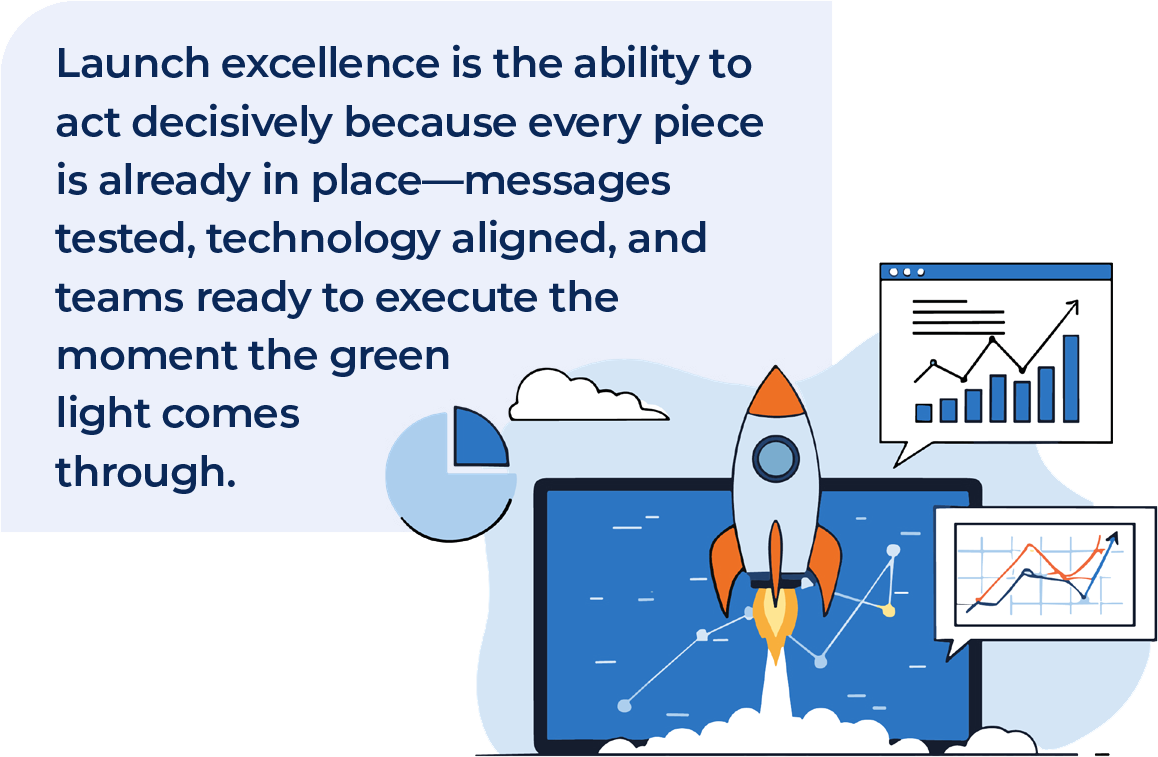
What Launch Excellence Really Looks Like
In pharma, timing defines success. The moment approval arrives, every team moves into motion with marketing, sales, medical, and compliance working in lockstep to communicate clearly and compliantly from day one.
For smaller and emerging companies, this comes from years of preparation, built on systems that connect content, data, and review processes long before approval.
How Conexus Helps:
Conexus Solutions, Inc. helps life sciences teams strengthen marketing operations so every launch runs with clarity, compliance, and control. We work with you to:
- Connect marketing, medical, and commercial functions through unified workflows.
- Integrate content, data, and technology to enable faster, compliant campaign execution.
- Streamline approval and review processes to reduce rework and speed up delivery.
- Design scalable frameworks that support omnichannel engagement and future innovation.
- Build operational maturity that keeps campaigns aligned across every audience and region.
Sources
1. Veeva Systems. Veeva Pulse Field Trends Report, 2024.
2. McKinsey & Company. Commercial Excellence in Life Sciences, 2023.
3. Gartner. Marketing Operations Benchmarking Survey, 2024.